



Operations6 min read
Stor-Mor
See how Stor-Mor successfully scaled from manually tracking leads on spreadsheets to managing over 300 dealers.
Around 2016, Jason Graber was selling sheds from a dealership in Sarasota and spending $200 a month on Google AdWords Express, the old local ad product. Jason recalls it bringing in about $20,000 a month. It looked like a money printer, so he doubled the budget to $400.
For two or three months, revenue stayed at $20,000. He was already the top result in Google. There were no more customers to buy, so he backed the spend down.
Most shed businesses never get that clear a signal. Fall ad budgets get booked on a gut feeling, a rep's pitch, or a buddy who swears by Facebook. A few thousand dollars go out with no way to tell what came back. On the "Sell More. Spend Less." webinar, Jason asked Jeremiah Smith of SimpleTiger to run a shed business through the same math he uses for his agency clients. This is the written version, organized so you can act on it before you book fall spend.
The full recording is embedded below. The written guide continues after it.
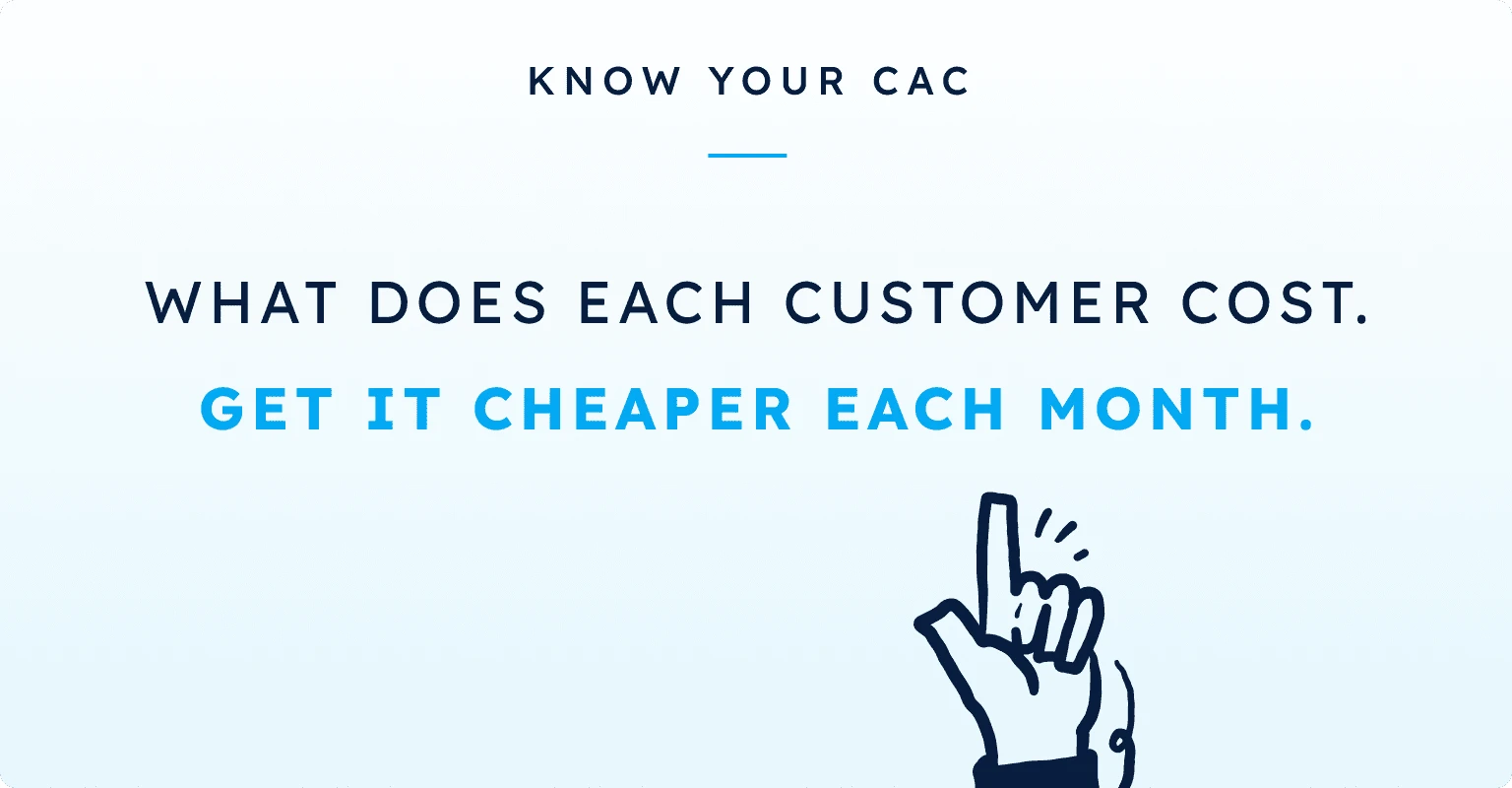
CAC stands for customer acquisition cost. Jeremiah's definition: "How much did it cost you to get that one customer that one time?"
What goes into the number
Pull these from your bookkeeping or ERP (the software that tracks your expenses):
Add it up for one month and divide by the customers you got that month.
The math, with Jeremiah's example
Jeremiah used round numbers to show the shape of it:
Those numbers are an illustration of the math, not a target for a shed business. The point is the baseline. Once you have it, the goal is to push it down while you put more money in. "Next month, let's try to get it down to 2,800. And then next month to 2,700."
Your homework: one month, then twelve
Jeremiah's assignment for everyone on the call: calculate CAC for last month. Then run it on a trailing 12 months. A busy season shows a low CAC. A slow season, when you're pushing ads to land a few extra builds, runs high.
Jason added that shed businesses have an advantage. A shed buyer decides faster than a software buyer, and you're moving 30 builds a month rather than three. That's more data, sooner.
ROAS stands for return on ad spend. It's the revenue you generated from what you spent on ads. Revenue, not profit, and that difference matters in this industry.
ROAS is revenue, not profit
A 2 to 1 ROAS means you spent $5,000 on ads and brought in $10,000 from those ads. Jeremiah said 2 to 1 is the lowest he hears about in software. Software can sometimes live with it because the margins are so high.
Jason's take: "In the shed world, that would be really bad." Spend $5,000 to bring in $10,000 and that's one shed. Your profit on one shed isn't $5,000. You're in the red.
Why a software benchmark doesn't fit a shed lot
In software, Jeremiah typically sees 5 to 9 times ROAS. Spend $10,000, get $50,000 back. He was plain that he doesn't know what a healthy ROAS is for the shed industry, and he didn't offer one. Margins on a physical product are a different world.
Work backward from one shed
Jeremiah's method: figure out how much you can afford to spend on advertising to sell one shed. That sets your ROAS target and your realistic ad budget. "What we don't wanna do is go sell 100 sheds this month with zero profitability. We'd rather sell 25 sheds with really strong profitability."
Once you have the number, you can tell an agency, "I need X ROAS for this to work." Jeremiah's view of what that does for you: "Now you are an informed client of a marketing team. You are a dangerous client because you know what you're looking for."
Jason's advice on top: you don't need to run your own marketing. You need to know enough to pick the right partner and tell whether they're doing the job.
Jeremiah sees the same three leaks in every kind of business he's around.

Leak 1: Spreading budget across too many platforms
Jeremiah calls it "flashy thing syndrome." A buddy says Facebook worked for him. Soon there are ten things running and the budget is gone. One of his business coaches, who grew a company past $100 million, put it this way: "Businesses don't die of starvation, they die of indigestion."
The fix:
Leak 2: Skipping negative keywords on Google
The second biggest waste Jeremiah sees is running Google Ads without negative keywords, the words that stop your ad from showing.
His example: you want to show up for "buy shed Sarasota Florida." You don't want to show up for "free shed Sarasota." Add "free" as a negative keyword and your ad stops showing to people hunting Facebook Marketplace and Craigslist.
Leak 3: Turning on the full budget on day one
A client comes in with $10,000 a month to spend. Jeremiah's team starts at $2,000 to $3,000 in month one and gets to the full amount in three or four months.
He compares it to training a puppy. Give Google a small taste. If it brings back a good customer, give it 20% more budget. Each time it delivers, increase again. That tells the algorithm it's doing the right thing.
Hand it $10,000 out of the gate and it shows your ad to "every Tom, Dick, and Harry on Google." The money is gone and Google learned nothing.
None of this means only ever run Google Ads. Jeremiah's growth framework:
Jason's AdWords Express story is the plateau in real life. Doubling the budget bought nothing because he already owned the top spot. Jeremiah's caution: someone else will find that channel too, and your costs will climb. Hold the throttle there and go find the next engine.
Shed Suite gives your team the leads, follow-up, and order pipeline this article describes — all in one place, trusted by 2,800+ shed businesses.
Book a DemoThis is where profit enters the picture. Once you know CAC and ROAS by channel, go into your books and find the actual profit on the sales each channel produced.
Rank channels by profit, then by room to grow
Jeremiah's framework is a three-column sheet:
A channel can be your most profitable and have zero room left, like Jason's AdWords Express. Profit alone says spend more there. Scalability says you can't, so you hold it steady and fund the next channel down.
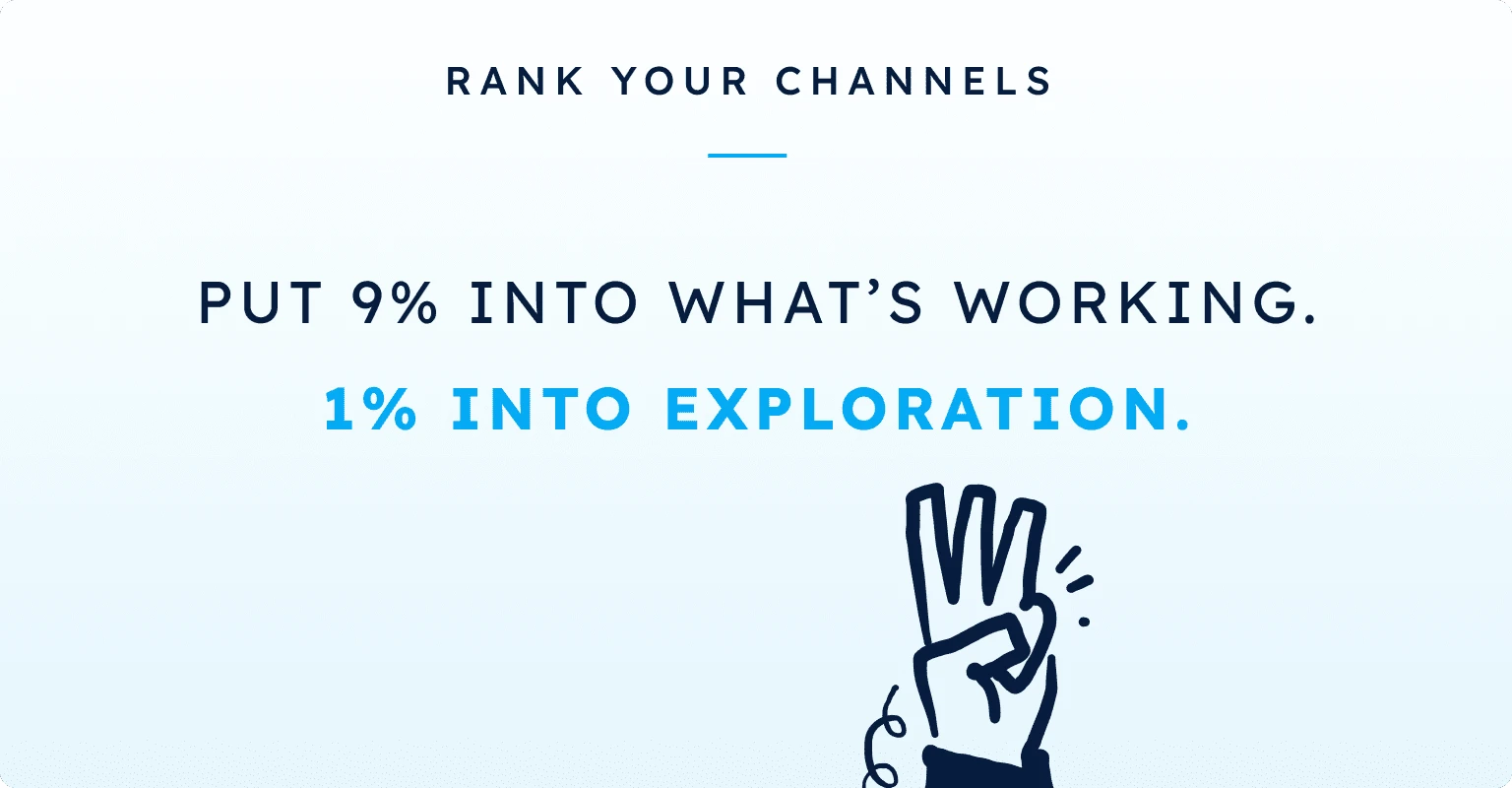
The 9% and 1% rule
Jeremiah's plea: "If you take anything away from this call, keep it simple." He admits he has flashy thing syndrome himself. His way of scratching that itch without wrecking the budget is an expense ratio.
His agency spends at least 10% of revenue on its own marketing. He doesn't know the right ratio for the shed industry, so treat 10% as his number, not yours. The split is what matters:
On $3 million in revenue, that's $300,000 on marketing with $30,000 to experiment. In a typical year his team tries five or six things with that money. Four flop. One lands a customer for something like $100. That one moves into the 9% bucket.
How many channels a shed company needs
Jason asked what a $5 million shed company should run. Jeremiah's rough rule of thumb: a fully worked channel takes about $10,000 a month. At $5 million he'd expect three solid channels as sure bets, with budget left to test a fourth and maybe a fifth.
He stressed the number is rough. Jason's read was that most shed companies sell locally and would hit a ceiling before $10,000 a month in one channel. The method holds either way.
Jason opened this section with a story. Driving through Georgia, he asked ChatGPT for the best value 6 by 12 enclosed trailer on his route. It came back with three options and reasons. He texted the top dealer, pulled in, and was out in 15 minutes with a $4,000 trailer. His question: how does a shed company capture that traffic?

Jeremiah's answer starts with SEO (search engine optimization, the work of showing up in search results). ChatGPT has pulled a lot of attention away from Google. The work to show up in either is mostly the same.
Start with the basics on your own site
Get other sites to mention your name
This is the piece that moves AI search. When ChatGPT sees "Acme Shed Company" on business sites all over Sarasota, it treats you as the real deal and recommends you. Places to earn those mentions:
Reviews do the steering
Jason asked how much a Google Business Profile matters. Jeremiah: "It's such table stakes that if you don't have one, you're already fighting an uphill battle."
Reviews are where it gets valuable. A customer writes, "Jim over at Acme helped install my wife's she-shed, and we live in Parrish." Now when someone in Parrish asks ChatGPT for a she shed, Jim's company is the answer. "If you don't have any reviews, the competitor of yours that does, they're gonna be the one that gets mentioned all the time."
Jason's view: no website and no Google Business Profile means you don't exist to a buyer who finds everything through ChatGPT or Google. Shed Suite customers already have an e-commerce site included.
Are ChatGPT ads worth it yet?
A dealer running Google paid search and some Meta asked about ChatGPT's new paid ads. Jeremiah's agency is running them for itself and one client, and he puts them in the 1% exploration bucket. Nobody knows how well they work yet.
Before you spend a dollar on any new channel, set up conversion tracking with UTM parameters (tags on your web address that record where a visitor came from). Without them you might land customers from ChatGPT and never know it, and you can't judge the channel's ROAS or CAC.
Jason said Shed Suite carries UTM data through to the CRM, so a lead's source stays attached. His caveat: tracking is never perfect. When people bounce between platforms, switch devices, or come back later to fill out the form, the source can get lost.
Should you be the face of the company on TikTok?
Another attendee asked whether personality-driven content, one person as the face of the company, is worth it. Jeremiah calls this personal branding and recommends it if you have something to say. The cost is less money than time, energy, and the discipline to ignore keyboard warriors.
He'd fund it from the exploration budget. His practical advice: record on your phone, not inside TikTok. Post the same clip to TikTok, Facebook, and Instagram and watch which one moves. And Jason added that it doesn't have to be you. If a salesperson on your crew has the energy for it, get behind them.
Does YouTube pay off?
For ads, Jeremiah finds longer YouTube spots work. A minute to a minute and a half of someone talking, with B-roll (overlay footage) of builds and deliveries. The catch is that people rarely leave YouTube to go buy something. Jason's framing: it's an attention play, and a remarketing play if you follow up with people who engaged.
If you'd rather have someone run the ads while you run the lot, Shed Suite Services (shedsuiteservices.com) handles paid marketing for shed businesses. Shed Suite CRM tracks the lead source so the CAC math is possible.
Ad spend without a customer acquisition cost is a guess. Know what a customer costs and work backward from what you can afford per shed. Use profit, not revenue, to decide where the next dollar goes.
Fund one channel at a time. Scale it slowly, hold it at the ceiling, then add the next. Keep 1% of revenue for experiments. And get your name on your site, on other people's sites, and in Google reviews. That's what AI reads when a buyer asks who to call.
Your one next step: pull last month's sales and marketing costs, divide by the customers you signed, and write that number down. That's your CAC. Everything else in this post starts there.
Casey Wiggins ran a lot before he ran a shed factory. His playbook for turning a dealer from first contact into a partner who stays, and keeping them busy.
A $40M custom home builder on why he wins as the highest bid, and how shed dealers can sell their best models without cutting the price.
Toli Marchuk and Jason Graber on what an AI agent is, the two tools to start with, and the automations a shed dealer can switch on with no developer.
See how real shed businesses scale and simplify with Shed Suite.
See how Stor-Mor successfully scaled from manually tracking leads on spreadsheets to managing over 300 dealers.
See how Backyard unified their e-commerce sales, inventory, and delivery teams using Shed Suite's all-in-one platform.

See how Legacy successfully automated sales, simplified inventory management, and improved delivery tracking to scale seamlessly.
Shed Suite clients see an average growth of 81% in their first year.
See how we do it — book a 30-minute demo.
Average sales growth across all Shed Suite clients, the 12 months before vs. after joining Shed Suite. As of 2026.
“We come from the shed industry and built this for y’all. We’d love to show you what we do, how it works, and how it’ll make every team member’s life so much easier and smoother.”

Jason Graber
Shed Suite Founder